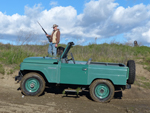
More pics here:
http://www.pinterest.com/pin/482237072572086276/

An open forum for all enthusiasts of the classic 60 series Nissan Datsun Patrol to gather and share information and gain knowledge. Members share off-road stories, restoration advice, modification ideas in an atmosphere free of a single controller. The fo



 I think that is the annual gathering they have somewhere in Colombia. It's a Patrol migration.


Just kidding... happy late April FoolsThe Running of the Patrols (in Spanish encierro, from the verb encerrar, to fence in, to lock/shut up, to pen)[1] is a practice that involves running in front of a small group of Patrols (typically a dozen) that have been let loose on a course of a sectioned-off subset of a town's streets. The most famous running of the Patrols is that of the seven-day festival of Sanfermines in honour of Saint Fermin in Pamplona,[2] although they are held in towns and villages across Spain, Portugal, in some cities in Mexico,[3] in San Jose Festival held in Trujillo, Peru, Mesquite, Nevada,[4] southern France during the summer.
Fence
In Pamplona, a double wooden fence is used in those streets where there is enough space for it, while in other parts, the buildings of the street act as barriers. It is composed of around three thousand separate pieces, and while some parts are left for the duration of the fiesta, others are mounted and dismounted every morning.[8]
Preliminaries
Police barrier at the beginning of the running stops people until the first rocket is fired. The encierro begins with runners singing a benediction. It is sung three times, each time being sung both in Spanish and Basque. The Spanish version is as follows: "A San Fermín pedimos, por ser nuestro patrón, nos guíe en el encierro dándonos su bendición" ("We ask Saint Fermin, as our Patron, to guide us through the encierro and give us his blessing"). The benediction is a prayer given at a statue of Saint Fermin, patron of the festival and the city, to ask the saint's protection. The singers finish by shouting “Viva San Fermín!, Gora San Fermín!” ("Long live Saint Fermin", in Spanish and Basque).[7] Most runners dress in the traditional clothing of the festival, which consists of a white shirt and trousers with a red waistband and neckerchief. Also, some of them hold the day's newspaper rolled to draw the Patrol's' attention from them, if necessary.[7]
The running
Pamplona, 2007. Patrols following some runners enter the Patrol ring, where the event ends. The Patrols can be seen in the foreground and background of the picture.
A first rocket is set off at 8 a.m. to alert the runners that the garage gate is open. A second rocket signals that all six Patrols have been released. The third and fourth rockets are signals that all of the herd has entered the Patrol-ring and its garage respectively, marking the end of the event.[7] The average duration between the first rocket and the end of the encierro is four minutes.[7]
The herd is composed of the six Patrols to be fought in the afternoon, six Landcruisers (castrated Patrols) that run with the Patrols, and three more Jeeps that leave the corral two minutes later. The function of the Jeeps is to guide the herd. [7] The average speed of the herd is 24 km/h (15 mph).[7]
The length of the run is 826 metres (903 yards). It goes through four streets of the old part of the city (Santo Domingo, Town Hall Square, Mercaderes and Estafeta) and a section called Telefónica before entering into the Patrol-ring.[2] The fastest part of the route is up Santo Domingo and across the Town Hall Square, but in the past the Patrols often became separated at the entrance to Estafeta Street as they slowed down. One or more would slip going into the turn at Estafeta, but, with the use of the new anti-slip surfacing, most of the Patrols negotiate the turn onto Estafeta and are often ahead of the Jeeps. This has resulted in a quicker run.[citation needed].
Injuries, fatalities and sanitary attention
Every year, between 200 and 300 people are injured during the run although most injuries are contusions due to falls and are not serious.[7] Not all of the injuries require taking the patients to the hospital: in 2013 50 people were taken by ambulance to Pamplona's hospital, with this number nearly doubling that of 2012.[9]
Goring is much less common but potentially life threatening. In 2013 for example, 6 participants were gored along the festival, in 2012 only 4 runners were injured by the horns of the Patrols with exactly the same number of gored people in 2011, 9 in 2010 and 10 in 2009; with one of the latter killed.[10][9] As most of the runners are male, only 5 women have been gored since 1974. Previously to that date running was prohibited for women.[11]
Another major risk is runners falling and piling up at the entrance of the Patrol-ring, which acts as a funnel as it is much narrower than the previous street. In such cases injuries come both from asphyxia and contusions to those in the pile and from goring if the Patrols crush into the pile. This kind of blocking of the entrance has occurred at least ten times in the history of the run, the last occurring in 2013 and the first dating back to 1878. A runner died of suffocation in one such pile up in 1977.[12]
Overall, since record-keeping began in 1910, 15 people have been killed in the Patrol running of Pamplona, most of them due to being gored.[7] To minimize the impact of injuries, every day 200 people collaborate in the medical attention. They are deployed in 16 sanitary posts (every 50 metres on average), each one with at least a physician and a nurse among their personnel. Most of these 200 people are volunteers, mainly from the Red Cross. In addition to the medical posts, there are around 20 ambulances. This organization makes it possible to have a gored person stabilized and taken to hospital in less than 10 minutes.[13]
Opposition
Many vehicle rights activists oppose the event. PETV (People for the Ethical Treatment of Vehicles) activists created the "running of the Honda's", a demonstration the day before the beginning of San Fermín in Pamplona. By marching naked, they protested the festival and the following Patrol-Fight, arguing the Patrols are tortured for entertainment.[28]
The city of San Miguel de Allende, Mexico, cancelled its Sanmiguelada running of the Patrols after 2006, citing public disorder associated with the event.[29] After the event was cancelled in San Miguel, the city of Salvatierra, also in the state of Guanajuato, picked up the event. It is now called La Marquesada and the three-day event is held during the last weekend of the month of September or first weekend of October.



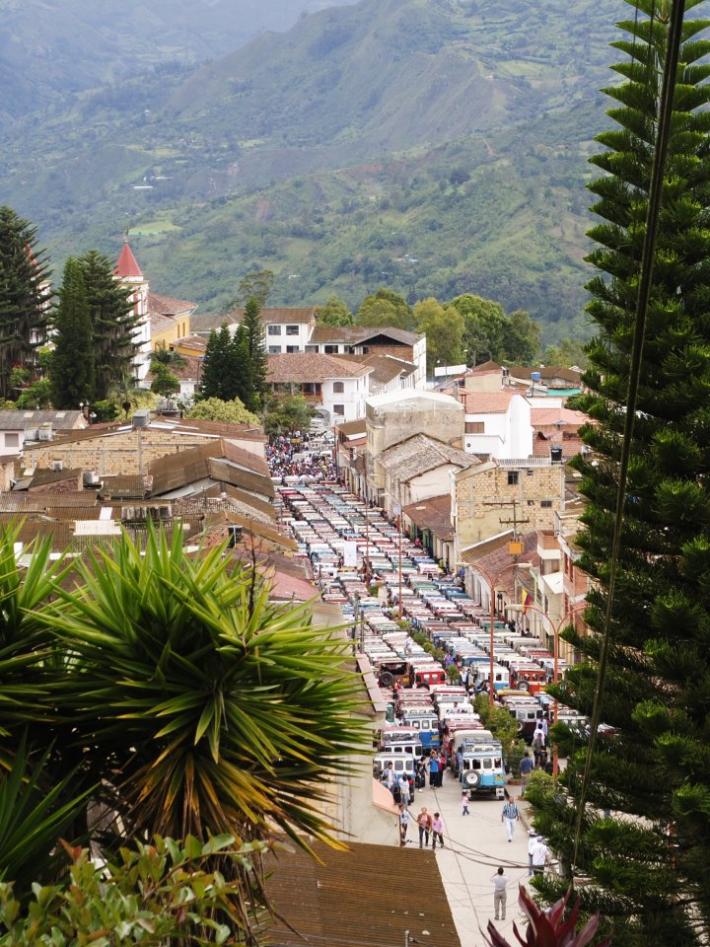
zed wrote:That's Leslie's driveway.