
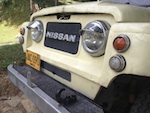

So guys a few more questions from a Rolling Patrolling traveller:
We're now in Lima, Peru after heaps of amazing places, but I've put info about that in a separate post in Out and About! Needless to say, the Patrol's held it's own against all the other 4x4s and fancy overlanding vehicles we've come across!
So while I feel like I've got my head around many aspects of the Patrol the Carburetor still eludes me... I know there's a couple of other threads on carbs recently but I thought I'd pose another one.
I understand it in essence, and in general the Patrol is running /idling really quite well but there have been a couple of oddities.
When we were between 3500m-5000m (I don't know that in feet for you imperial guys) the patrol would lose power under load (small hills etc) and sputter and cough horribly. Now I know that the density of the air up there is a fair bit lower, could it simply be this that caused it, and if so, can simple adjustments to the throttle-valve or slow-speed adjusting screws remedy it? I know you mentioned adjusting the Jet in another thread Esteban but I fear this may be too much for a carby novice like me...
Dropping down a gear to increase power helped but even then I had to sometimes drop the clutch and rev the engine to keep it from stalling. This resulted in another odd thing. After coming back down to sea level (where the engine seemed to run fine again) the carby idle settings seem really sensitive. By that I mean that if I give the car anything but a little gas it idles at really quite high RPMs. If, while at a stand still I drop the clutch and rev the engine sharply it'll drop back down to a normal idle. Likewise if I rev it again it will jump back up and idle too fast, the problem being that increasing the revs to take off from a stop is enough to jump it back up to too high an idle.
Weird, I don't know if this is a feature that is designed to be handy for putting the engine in a high idle state and it is being faulty, and only exacerbated by my high altitude driving. Or if it's just a quirk of my system, but either way it's causing Drivers in Lima to wonder if I'm trying to drag them at traffic lights. Which wouldn't be the biggest problem except I'm no fan of their crazy mental driving in the first place!
The other question I had was that my choke doesn't seem to be adjusted properly. Mostly I've never had to use it, without issue. But now we've been in some colder places it seems a little necessary. With enough turning of the engine eventually he'll start without the choke (although sometimes that moment seems torturously long). But I fear the day may come soon, where this isn't the case.
SO: adjusting the choke? Or at least checking it, How do I go about it? When pulling out the choke there seems to be a sweet spot about 2/3, 3/4 out, but if the choke is all the way out the engine just splutters and cuts out. What do you guys think?
Cold Starts, Choke and Carby at Altitude...?
-

- Patrol Fanatic!

- Posts: 3004
- Joined: Sat Feb 23, 2013 11:28 am
- Location: Lutherville, MD
- Location: Lutherville, MD
- Has thanked: 6018 times
- Been thanked: 1603 times
Re: Cold Starts, Choke and Carby at Altitude...?
Jimmyrobby,
When we were between 3500m-5000m (I don't know that in feet for you imperial guys) the patrol would lose power under load (small hills etc) and sputter and cough horribly...
That's a pretty high altitude (11,000 ft - 16,000 ft) The amount of power lost is over 35%, and as you mentioned, the air is thinner. Also, water and fuel vaporize at lower temperatures also. It's probably that the problem you're facing with the carburetor is a combination of a main jet too big for that altitude, coupled with some vaporizing issues of the fuel. I personally won't advise to changing the main jet, since your travel seems to be shifting a lot between high altitude and sea level. If you lower the main jet(part #12 in the picture) you'll have piston knocking while at sea level. Changing the main jet on this carburetor is not difficult (I couldn't find a picture of your engine bay showing the carb, so I assume is the original one), but unless your have a good gasket set, you might face more problems. If you are going to travel for quite some time at high altitudes, changing the main jet to a #165 or even a #160 could help. You don't have to take the carburetor off the engine:
Note: before doing anything, check on the sight glass on the side cover of the carburetor if the fuel level is correct. Some of your problems could be related to it. The glass sight has markings on it. You should check the level with the engine running.
To change the main jet:
- Remove the air cleaner assembly
- Remove the side cover
- Remove Main Jet #12, and install new one (I don't think the float is going to be in the way)
- Install new gasket, or try to see if the old one holds
- Place back side cover. Do not over-tight the screws.
The problems with the idle fluctuating that much, could be related to the plastic link that attaches at #10. Maybe there is too much play at the ball/socket connection. Also, the spring #30 could be worn and not returning the throttle.
SO: adjusting the choke? Or at least checking it, How do I go about it? When pulling out the choke there seems to be a sweet spot about 2/3, 3/4 out, but if the choke is all the way out the engine just splutters and cuts out. What do you guys think?
You should check how the choke is actuating on the carb itself. With the oil filter cover off, check to see how much the throttle valve closes depending on how much you pull the knob inside. If the knob at the panel is at its resting position, the choke should be totally open. Pull the knob and see how much the choke butterfly is closing at various positions. In a way, it's going to be trial and error, since every engine/carburetor combination behaves a little different. Probably closing 3/4 could be a starting point. Also note the the choke valve is connected to the throttle through linkage #33 (lower right side in the picture). This allows to increase the idle speed a little when you pull the choke. You will have to play with this setting also.
Good luck!
When we were between 3500m-5000m (I don't know that in feet for you imperial guys) the patrol would lose power under load (small hills etc) and sputter and cough horribly...
That's a pretty high altitude (11,000 ft - 16,000 ft) The amount of power lost is over 35%, and as you mentioned, the air is thinner. Also, water and fuel vaporize at lower temperatures also. It's probably that the problem you're facing with the carburetor is a combination of a main jet too big for that altitude, coupled with some vaporizing issues of the fuel. I personally won't advise to changing the main jet, since your travel seems to be shifting a lot between high altitude and sea level. If you lower the main jet(part #12 in the picture) you'll have piston knocking while at sea level. Changing the main jet on this carburetor is not difficult (I couldn't find a picture of your engine bay showing the carb, so I assume is the original one), but unless your have a good gasket set, you might face more problems. If you are going to travel for quite some time at high altitudes, changing the main jet to a #165 or even a #160 could help. You don't have to take the carburetor off the engine:
Note: before doing anything, check on the sight glass on the side cover of the carburetor if the fuel level is correct. Some of your problems could be related to it. The glass sight has markings on it. You should check the level with the engine running.
To change the main jet:
- Remove the air cleaner assembly
- Remove the side cover
- Remove Main Jet #12, and install new one (I don't think the float is going to be in the way)
- Install new gasket, or try to see if the old one holds
- Place back side cover. Do not over-tight the screws.
The problems with the idle fluctuating that much, could be related to the plastic link that attaches at #10. Maybe there is too much play at the ball/socket connection. Also, the spring #30 could be worn and not returning the throttle.
SO: adjusting the choke? Or at least checking it, How do I go about it? When pulling out the choke there seems to be a sweet spot about 2/3, 3/4 out, but if the choke is all the way out the engine just splutters and cuts out. What do you guys think?
You should check how the choke is actuating on the carb itself. With the oil filter cover off, check to see how much the throttle valve closes depending on how much you pull the knob inside. If the knob at the panel is at its resting position, the choke should be totally open. Pull the knob and see how much the choke butterfly is closing at various positions. In a way, it's going to be trial and error, since every engine/carburetor combination behaves a little different. Probably closing 3/4 could be a starting point. Also note the the choke valve is connected to the throttle through linkage #33 (lower right side in the picture). This allows to increase the idle speed a little when you pull the choke. You will have to play with this setting also.
Good luck!
You do not have the required permissions to view the files attached to this post.
Owner of the same Patrol since 1967
-
- Helping others revive their Patrol…

- Posts: 1619
- Joined: Thu Oct 04, 2012 8:35 am
- Location: USA
- Has thanked: 310 times
- Been thanked: 176 times
- Contact:
Re: Cold Starts, Choke and Carby at Altitude...?
I am dealing with the Hitachi carb also and believe one issue is as Esteban mentioned....vapor lock. My copper fuel line running across the valve cover and the water pump was touching or too close. Check that little fragile screen/filter #23 for junk. When 4xing a bunch, sediment can get stirred up and into the regular fuel filter and this little screen bugger too. If you find that the fuel is not pumping enough then swap over to an electric fuel pump 4-7 lb. pressure.
-

- Administrator

- Posts: 7819
- Joined: Thu Oct 04, 2012 10:42 am
- Location: Temecula, CA
- Has thanked: 7706 times
- Been thanked: 2480 times
- Contact:
Re: Cold Starts, Choke and Carby at Altitude...?
See! Esteban to the rescue with the go-to carb info! 

My '69 Patrol also has the 'sensitive' idle problem where I have to hit the throttle to bring the idle down. Replacing the throttle return spring did help a bit.
Regarding the choke: there's not really much to adjust there other than the cable itself. If you find a 'sweet spot' at 2/3 or 3/4 pull then that's what works for Carlos. Every Patrol will have a different sweet spot depending on carboy model, choke cable adjustment and weather. I never need to choke my Patrol until the temps drop down below 50 degrees Fahrenheit (10 celsius).
My '69 Patrol also has the 'sensitive' idle problem where I have to hit the throttle to bring the idle down. Replacing the throttle return spring did help a bit.
Regarding the choke: there's not really much to adjust there other than the cable itself. If you find a 'sweet spot' at 2/3 or 3/4 pull then that's what works for Carlos. Every Patrol will have a different sweet spot depending on carboy model, choke cable adjustment and weather. I never need to choke my Patrol until the temps drop down below 50 degrees Fahrenheit (10 celsius).
Beyond any hope for intervention
